Sunday, June 24, 2018

English Phonetics and Pronunciation Guide with Audio Examples


English Phonetics and Pronunciation Guide with Audio Examples

This portion of the site is intended for advanced English learners and our international visitors.

Test your vocabulary

English phonetic alphabet (transcription)


English pronunciation


Bold letters for given sound


Easy to use one button player


Did you ever feel like breaking down because of English spelling? Don't worry, English spelling and pronunciation system is very confusing and often puzzles even the native speaker. Dr. Edward Rondthaler the noted typographist, the chairman of the American Literary Council and master of the English language says that "nothing seems to be spelled, or said, quite the way you expect it to be!" In fact there are two English languages — the Written English and the Spoken or Phonetic English. But if you really want to communicate, which means speak, understand, read and write English, you have to deal with both of them.

There are 26 letters in the English alphabet but they stand for at least 44 sounds of real English. The table below contains phonetic symbols used in various English dictionaries and their audio pronunciation (MP3 format). However it doesn't list all possible sounds of American or British English considering that some researchers count up to 49 (or even more) distinct sounds in English language. The number of sounds and sounds themselves depend of course on dialect i.e. country, area and … evaluation procedure.

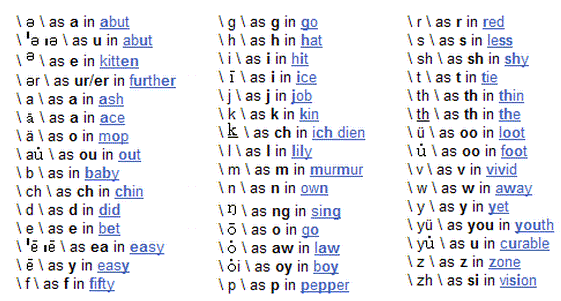
There are quite a few phonetic transcription systems in the world. Some of them are too sophisticated to learn, the others are too simple to feature all sounds of English. The most popular and commonly used among them is the International Phonetic Alphabet (IPA). IPA is used by Oxford dictionaries and virtually all printed and digital dictionaries worldwide, except American ones. American dictionaries each make up their own peculiar pattern. The most known of them are the Merriam Webster and American Heritage Dictionary. The Longman Dictionary of American English uses IPA, which could have been an exception to the rule if it hadn't been issued by British publisher named Pearson. There are some similarities but also many differences between these systems especially in the way they express vowels. The main table here represents the IPA alphabet while at the bottom of the page you will find a guide to Merriam Webster Pronunciation. Compare and choose...

Phonetic transcription is usually written in [square brackets] or between two \backslash symbols\. 
Stress: main stress is a short vertical or slant line placed at the top before the stressed syllable in the phonetic transcription of the word; secondary stress is a short vertical or slant line placed at the bottom before the stressed syllable. E.g.: 

And now all you have to do is read, listen and repeat as much as possible!

 Continuous Play

English Phonetics — Reference Table

Vowels (Monophthongs)

IPA Phonetic SymbolExamplesi ːtree, sea, receive, women, believe, we, peopleɪbit, symbol, recall, businessæcat, apple, compactɑːcar, far, garage, heartɔːsort, ball, ought, awful, board, floor, audacity, sawʊput, foot, could, butcher, womanu ːfool, rule, shoes, true, crew, move, throughʌup, other, but, couple, blood, loveɜ ːher, first, turn, search, wordəuntil, about, aliasebed, effort, head, said, friendɒrock, impossible, body, cough, knowledge

Diphthongs

IPA Phonetic SymbolExampleseɪtrayeight, make, sail, say, great, aceaɪskyI, bye, buy, by, guide, flight, rye, die, choir ['kwair]ɔɪjoy, coin, oysterɪə (-r amer.)fear, beer, hereeə (-r amer.)hair, care, there, hareʊə (-r amer.)tour, pooraʊtrousers, cowhour, ourəʊjoke, coat, own, go, though, sew, toe

Consonants

IPA Phonetic SymbolExamplespparking, gallop, openbboard, tab, abandonttrunk, request, receiptdadd, addiligentkkodakcord, accomplish, school, ache, conqueror, exchange (x = k+s)ggrace, agree auxiliary (x = g+z)tʃchance, achieve, catch, mutualdʒjungle, judge, logic, procedureffool, atmosphere, enoughvvocal, givthanks, ethicðthere, otherssunday, citizen, east, scissors, psychologyzzebra, cosmonaut, scissors,resign, xenonʃshine, sure, action, special, issue, conscience, anxious (x = k + ʃ)ʒvisual, casual, usual, garage,hhead, uphillmmother, lambnnote, intrusion, knowledge, pneumaticŋsing, sinkllaughter, illegalrrandom, orange; (amer.) orderjyet, yesterday, you, utility; (u = j + u)wwhat, windows, quest, one (o = w + ʌ)

Compare IPA Phonetic Alphabet with Merriam Webster Pronunciation Symbols. 
Although some similarities are present there are also many differences between these two phonetic Alphabets.


Английский онлайн:


Приятное с Полезным:


Популярное:


Неправильные глаголы за 90 минут Английский для водителя дальнобойщикаАнглийский для строителяЦвета на английском Бизнес и бейсбол: что у них общего? Попрошу без мата!

Новое на сайте:

Летим на луну Большие красные грузовикиСловарь с картинками: Женская одежда Самый неприличный вопрос на английском Машинный перевод, искусственный интеллект и нейронные сетиКак начать разговор на английском? Как написать деловое письмо на английском?

Приятное с полезным по-английски:


Тигр — Tiger Chamomile — ромашка Лимон — Lemon Английский алфавит Анекдот по-английски Bear — Медведь Sweet pepper — Сладкий перец Пентагон? Кухонный словарь Трудности перевода


 Условия использования


Политика конфиденциальности


Copyright © audio-class.ru 2017. Все права защищены


Verbs followed by ‘ing’ or by ‘to + infinitive’ 1


Verbs followed by ‘ing’ or by ‘to + infinitive’ 1

 9

Read the grammar explanation and do the exercise.

When one verb is followed by another, the second verb can either be an

infinitive

or an

–ing

form. Some verbs can be followed by only an

infinitive

, others by only an

–ing

form and some by both but with a change in meaning. To know which structure to use, you can consult a good dictionary but here are some common examples.


Verb + infinitive

I want to speak to the manager.


She’s learning to ride a horse.


He offered to help us wash up.


Want’, ’learn’ and ‘offer’ are followed by to + infinitive

Other verbs in this group include: affordagreeaskchoosedecideexpecthopepreparepromisepretendrefusewould like.

Verb + ‘ing’ form

I enjoy travelling.


He admitted stealing the necklace.


I don’t mind waiting if you’re busy.


enjoy’ ‘admit’ and ‘mind’ are followed by the ‘ing’ form

Other verbs in this group include: avoidconsiderdislikefeel likefinishgive upcan’t helppractisesuggest.

Verb + infinitive or ‘ing’ form with no change in meaning

A few verbs can be followed by either an infinitive or the ‘ing’ form and the meaning does not change.

I started to work here in 1994.


I started working here in 1994.


The meaning of these two sentences is the same.

There aren’t many verbs that can take an infinitive or an ‘ing’ form with no change in meaning. ‘Begin’ and ‘continue’ are two more examples.

There is also a group of verbs that can be followed by an infinitive or an ‘ing’ form with a change in meaning. These verbs will be covered in another section.


Tags

Verb: Tenses Aspects Moods Grammar: infinitive or ing?

Elementary: A2

Intermediate: B1

LearnEnglish Grammar

HELP & SUPPORT

Getting started


Find out your English level


Why register?


House Rules


Frequently asked questions


COURSES

Find a face-to-face or online course near you.


BACK TO TOP


Twitter


Facebook


Email


© British Council
The United Kingdom's international organisation for cultural relations and educational opportunities.
A registered charity: 209131 (England and Wales) SC037733 (Scotland).

ICP#: 10044692


This site uses cookies to help make it more useful to you.


By continuing to browse the site we understand this is acceptable to you. Learn about managing cookies.

Yes, I agree No, I want to find out more


Search form


Search

You are here

Home » Grammar » Basic grammar

Verbs followed by ‘ing’ or by ‘to + infinitive’ 1

 9

Read the grammar explanation and do the exercise.

When one verb is followed by another, the second verb can either be an

infinitive

or an

–ing

form. Some verbs can be followed by only an

infinitive

, others by only an

–ing

form and some by both but with a change in meaning. To know which structure to use, you can consult a good dictionary but here are some common examples.


Verb + infinitive

I want to speak to the manager.


She’s learning to ride a horse.


He offered to help us wash up.


Want’, ’learn’ and ‘offer’ are followed by to + infinitive

Other verbs in this group include: affordagreeaskchoosedecideexpecthopepreparepromisepretendrefusewould like.

Verb + ‘ing’ form

I enjoy travelling.


He admitted stealing the necklace.


I don’t mind waiting if you’re busy.


enjoy’ ‘admit’ and ‘mind’ are followed by the ‘ing’ form

Other verbs in this group include: avoidconsiderdislikefeel likefinishgive upcan’t helppractisesuggest.

Verb + infinitive or ‘ing’ form with no change in meaning

A few verbs can be followed by either an infinitive or the ‘ing’ form and the meaning does not change.

I started to work here in 1994.


I started working here in 1994.


The meaning of these two sentences is the same.

There aren’t many verbs that can take an infinitive or an ‘ing’ form with no change in meaning. ‘Begin’ and ‘continue’ are two more examples.

There is also a group of verbs that can be followed by an infinitive or an ‘ing’ form with a change in meaning. These verbs will be covered in another section.


Tags

Verb: Tenses Aspects Moods Grammar: infinitive or ing?

Elementary: A2

Intermediate: B1

LearnEnglish Grammar

HELP & SUPPORT

Getting started


Find out your English level


Why register?


House Rules


Frequently asked questions


COURSES

Find a face-to-face or online course near you.


BACK TO TOP


Twitter


Facebook


Email


© British Council
The United Kingdom's international organisation for cultural relations and educational opportunities.
A registered charity: 209131 (England and Wales) SC037733 (Scotland).

ICP#: 10044692


This site uses cookies to help make it more useful to you.


By continuing to browse the site we understand this is acceptable to you. Learn about managing cookies.

Yes, I agree No, I want to find out more

ShareThis Copy and Paste

Skip to main content Search form Search You are here Home » Grammar » Basic grammar Verbs followed by ‘ing’ or by ‘to + infinitive’ 1  9 Read the grammar explanation and do the exercise. When one verb is followed by another, the second verb can either be an infinitive or an –ing form. Some verbs can be followed by only an infinitive , others by only an –ing form and some by both but with a change in meaning. To know which structure to use, you can consult a good dictionary but here are some common examples.   Verb + infinitive I want to speak to the manager. She’s learning to ride a horse. He offered to help us wash up. ‘Want’, ’learn’ and ‘offer’ are followed by to + infinitive Other verbs in this group include: afford, agree, ask, choose, decide, expect, hope, prepare, promise, pretend, refuse, would like. Verb + ‘ing’ form I enjoy travelling. He admitted stealing the necklace. I don’t mind waiting if you’re busy. ‘enjoy’ ‘admit’ and ‘mind’ are followed by the ‘ing’ form Other verbs in this group include: avoid, consider, dislike, feel like, finish, give up, can’t help, practise, suggest. Verb + infinitive or ‘ing’ form with no change in meaning A few verbs can be followed by either an infinitive or the ‘ing’ form and the meaning does not change. I started to work here in 1994. I started working here in 1994. The meaning of these two sentences is the same. There aren’t many verbs that can take an infinitive or an ‘ing’ form with no change in meaning. ‘Begin’ and ‘continue’ are two more examples. There is also a group of verbs that can be followed by an infinitive or an ‘ing’ form with a change in meaning. These verbs will be covered in another section.   Tags Verb: Tenses Aspects Moods ›Grammar: infinitive or ing? Elementary: A2Intermediate: B1 LearnEnglish Grammar HELP & SUPPORT Getting started Find out your English level Why register? House Rules Frequently asked questions COURSES Find a face-to-face or online course near you. BACK TO TOP Twitter Facebook Email Terms of use Accessibility Privacy and cookies Contact us Site map © British Council The United Kingdom's international organisation for cultural relations and educational opportunities. A registered charity: 209131 (England and Wales) SC037733 (Scotland). ICP#: 10044692 This site uses cookies to help make it more useful to you. By continuing to browse the site we understand this is acceptable to you. Learn about managing cookies. Yes, I agree No, I want to find out more Skip to main content Search form Search You are here Home » Grammar » Basic grammar Verbs followed by ‘ing’ or by ‘to + infinitive’ 1  9 Read the grammar explanation and do the exercise. When one verb is followed by another, the second verb can either be an infinitive or an –ing form. Some verbs can be followed by only an infinitive , others by only an –ing form and some by both but with a change in meaning. To know which structure to use, you can consult a good dictionary but here are some common examples.   Verb + infinitive I want to speak to the manager. She’s learning to ride a horse. He offered to help us wash up. ‘Want’, ’learn’ and ‘offer’ are followed by to + infinitive Other verbs in this group include: afford, agree, ask, choose, decide, expect, hope, prepare, promise, pretend, refuse, would like. Verb + ‘ing’ form I enjoy travelling. He admitted stealing the necklace. I don’t mind waiting if you’re busy. ‘enjoy’ ‘admit’ and ‘mind’ are followed by the ‘ing’ form Other verbs in this group include: avoid, consider, dislike, feel like, finish, give up, can’t help, practise, suggest. Verb + infinitive or ‘ing’ form with no change in meaning A few verbs can be followed by either an infinitive or the ‘ing’ form and the meaning does not change. I started to work here in 1994. I started working here in 1994. The meaning of these two sentences is the same. There aren’t many verbs that can take an infinitive or an ‘ing’ form with no change in meaning. ‘Begin’ and ‘continue’ are two more examples. There is also a group of verbs that can be followed by an infinitive or an ‘ing’ form with a change in meaning. These verbs will be covered in another section.   Tags Verb: Tenses Aspects Moods ›Grammar: infinitive or ing? Elementary: A2Intermediate: B1 LearnEnglish Grammar HELP & SUPPORT Getting started Find out your English level Why register? House Rules Frequently asked questions COURSES Find a face-to-face or online course near you. BACK TO TOP Twitter Facebook Email Terms of use Accessibility Privacy and cookies Contact us Site map © British Council The United Kingdom's international organisation for cultural relations and educational opportunities. A registered charity: 209131 (England and Wales) SC037733 (Scotland). ICP#: 10044692 This site uses cookies to help make it more useful to you. By continuing to browse the site we understand this is acceptable to you. Learn about managing cookies. Yes, I agree No, I want to find out more ShareThis Copy and Paste

Question forms & subject/object questions


Question forms & subject/object questions

 18

Read the grammar explanation and do the exercise.

To form yes/no questions where there is an auxiliary verb or a modal verb, we invert the word order of a positive sentence.

Question forms & subject/object questions

Review of question forms

Yes/No questions

Is he a teacher? Yes he is.


Can you swim? No, I can’t.


Have they got a car? Yes they have.


To form yes/no questions where there is an auxiliary verb or a modal verb, we invert the word order of a positive sentence. (He is a teacher > Is he a teacher?)

Do you eat fish? No I don’t.


Does she know you. Yes she does.


When there is no auxiliary verb we use ‘do’ to form the question.

With question words

The same rules apply when there is a question word (‘what’, ‘where’, ‘when’, ‘why’, ‘who’, ‘which’, ‘how’, ‘how much’, ‘how many’)

Where is the hotel?


What can you smell?


Who has just arrived?


Where there is an auxiliary or modal verb, that verb is used to form the question.

How did you get here?


When do your parents get back?


How much does it cost?


Where there is no auxiliary verb, we use do.

Subject/Object questions

Sometimes you might see questions like this.

Who broke the window?


What happened next?


Who told you that?


There is no auxiliary verb and the word order is not inverted.

These are called subject questions – because the question word is the subject of the sentence.

Look at these two questions.

Who does Romeo love? Romeo loves Juliet.


Who loves Romeo? Juliet loves Romeo.


In the first question, Romeo is the subject of the verb.
In the second question ‘who’ is the subject and Romeo is the object.


Tags

Verb: QuestionsGrammar: inversion

Verb: QuestionsGrammar: question words

Elementary: A2

LearnEnglish Grammar

HELP & SUPPORT

Getting started


Find out your English level


Why register?


House Rules


Frequently asked questions


COURSES

Find a face-to-face or online course near you.


BACK TO TOP


Twitter


Facebook


Email


© British Council
The United Kingdom's international organisation for cultural relations and educational opportunities.
A registered charity: 209131 (England and Wales) SC037733 (Scotland).

ICP#: 10044692


This site uses cookies to help make it more useful to you.


By continuing to browse the site we understand this is acceptable to you. Learn about managing cookies.

Yes, I agree No, I want to find out more


Search form


Search

You are here

Home » Grammar » Basic grammar

Question forms & subject/object questions

 18

Read the grammar explanation and do the exercise.

To form yes/no questions where there is an auxiliary verb or a modal verb, we invert the word order of a positive sentence.

Question forms & subject/object questions

Review of question forms

Yes/No questions

Is he a teacher? Yes he is.


Can you swim? No, I can’t.


Have they got a car? Yes they have.


To form yes/no questions where there is an auxiliary verb or a modal verb, we invert the word order of a positive sentence. (He is a teacher > Is he a teacher?)

Do you eat fish? No I don’t.


Does she know you. Yes she does.


When there is no auxiliary verb we use ‘do’ to form the question.

With question words

The same rules apply when there is a question word (‘what’, ‘where’, ‘when’, ‘why’, ‘who’, ‘which’, ‘how’, ‘how much’, ‘how many’)

Where is the hotel?


What can you smell?


Who has just arrived?


Where there is an auxiliary or modal verb, that verb is used to form the question.

How did you get here?


When do your parents get back?


How much does it cost?


Where there is no auxiliary verb, we use do.

Subject/Object questions

Sometimes you might see questions like this.

Who broke the window?


What happened next?


Who told you that?


There is no auxiliary verb and the word order is not inverted.

These are called subject questions – because the question word is the subject of the sentence.

Look at these two questions.

Who does Romeo love? Romeo loves Juliet.


Who loves Romeo? Juliet loves Romeo.


In the first question, Romeo is the subject of the verb.
In the second question ‘who’ is the subject and Romeo is the object.


Tags

Verb: QuestionsGrammar: inversion

Verb: QuestionsGrammar: question words

Elementary: A2

LearnEnglish Grammar

HELP & SUPPORT

Getting started


Find out your English level


Why register?


House Rules


Frequently asked questions


COURSES

Find a face-to-face or online course near you.


BACK TO TOP


Twitter


Facebook


Email


© British Council
The United Kingdom's international organisation for cultural relations and educational opportunities.
A registered charity: 209131 (England and Wales) SC037733 (Scotland).

ICP#: 10044692


This site uses cookies to help make it more useful to you.


By continuing to browse the site we understand this is acceptable to you. Learn about managing cookies.

Yes, I agree No, I want to find out more

ShareThis Copy and Paste

Skip to main content Search form Search You are here Home » Grammar » Basic grammar Question forms & subject/object questions  18 Read the grammar explanation and do the exercise. To form yes/no questions where there is an auxiliary verb or a modal verb, we invert the word order of a positive sentence. Question forms & subject/object questions Review of question forms Yes/No questions Is he a teacher? Yes he is. Can you swim? No, I can’t. Have they got a car? Yes they have. To form yes/no questions where there is an auxiliary verb or a modal verb, we invert the word order of a positive sentence. (He is a teacher > Is he a teacher?) Do you eat fish? No I don’t. Does she know you. Yes she does. When there is no auxiliary verb we use ‘do’ to form the question. With question words The same rules apply when there is a question word (‘what’, ‘where’, ‘when’, ‘why’, ‘who’, ‘which’, ‘how’, ‘how much’, ‘how many’) Where is the hotel? What can you smell? Who has just arrived? Where there is an auxiliary or modal verb, that verb is used to form the question. How did you get here? When do your parents get back? How much does it cost? Where there is no auxiliary verb, we use do. Subject/Object questions Sometimes you might see questions like this. Who broke the window? What happened next? Who told you that? There is no auxiliary verb and the word order is not inverted. These are called subject questions – because the question word is the subject of the sentence. Look at these two questions. Who does Romeo love? Romeo loves Juliet. Who loves Romeo? Juliet loves Romeo. In the first question, Romeo is the subject of the verb. In the second question ‘who’ is the subject and Romeo is the object.   Tags Verb: Questions›Grammar: inversionVerb: Questions›Grammar: question words Elementary: A2 LearnEnglish Grammar HELP & SUPPORT Getting started Find out your English level Why register? House Rules Frequently asked questions COURSES Find a face-to-face or online course near you. BACK TO TOP Twitter Facebook Email Terms of use Accessibility Privacy and cookies Contact us Site map © British Council The United Kingdom's international organisation for cultural relations and educational opportunities. A registered charity: 209131 (England and Wales) SC037733 (Scotland). ICP#: 10044692 This site uses cookies to help make it more useful to you. By continuing to browse the site we understand this is acceptable to you. Learn about managing cookies. Yes, I agree No, I want to find out more Skip to main content Search form Search You are here Home » Grammar » Basic grammar Question forms & subject/object questions  18 Read the grammar explanation and do the exercise. To form yes/no questions where there is an auxiliary verb or a modal verb, we invert the word order of a positive sentence. Question forms & subject/object questions Review of question forms Yes/No questions Is he a teacher? Yes he is. Can you swim? No, I can’t. Have they got a car? Yes they have. To form yes/no questions where there is an auxiliary verb or a modal verb, we invert the word order of a positive sentence. (He is a teacher > Is he a teacher?) Do you eat fish? No I don’t. Does she know you. Yes she does. When there is no auxiliary verb we use ‘do’ to form the question. With question words The same rules apply when there is a question word (‘what’, ‘where’, ‘when’, ‘why’, ‘who’, ‘which’, ‘how’, ‘how much’, ‘how many’) Where is the hotel? What can you smell? Who has just arrived? Where there is an auxiliary or modal verb, that verb is used to form the question. How did you get here? When do your parents get back? How much does it cost? Where there is no auxiliary verb, we use do. Subject/Object questions Sometimes you might see questions like this. Who broke the window? What happened next? Who told you that? There is no auxiliary verb and the word order is not inverted. These are called subject questions – because the question word is the subject of the sentence. Look at these two questions. Who does Romeo love? Romeo loves Juliet. Who loves Romeo? Juliet loves Romeo. In the first question, Romeo is the subject of the verb. In the second question ‘who’ is the subject and Romeo is the object.   Tags Verb: Questions›Grammar: inversionVerb: Questions›Grammar: question words Elementary: A2 LearnEnglish Grammar HELP & SUPPORT Getting started Find out your English level Why register? House Rules Frequently asked questions COURSES Find a face-to-face or online course near you. BACK TO TOP Twitter Facebook Email Terms of use Accessibility Privacy and cookies Contact us Site map © British Council The United Kingdom's international organisation for cultural relations and educational opportunities. A registered charity: 209131 (England and Wales) SC037733 (Scotland). ICP#: 10044692 This site uses cookies to help make it more useful to you. By continuing to browse the site we understand this is acceptable to you. Learn about managing cookies. Yes, I agree No, I want to find out more ShareThis Copy and Paste

Past Continuous and Past Simple


Past Continuous and Past Simple

 81

Read about the past continuous and past simple tenses and then do the exercise.

1.  The most common use of the past continuoustense is to talk about something that was happening around a particular time in the past.

What were you doing at 8 o’clock last night? I was watching television.


I started watching television before 8 o’clock and I continued watching it after 8 o’clock.

In 1994 he was working in a small town in Poland.

At 6 o’clock on Saturday morning we were travelling to the airport.


2. We often use the past continuous and the past simple tense together. When this happens, the past continuous describes a longer, ‘background’ action or situation and the past simple describes the action or events.

When I woke up this morning it was raining and my father was singing in the kitchen.

I was walking home, whistling happily, when I saw two masked men run out of the bank.


Often, the ‘action’ described by the past simpletense interrupts the ‘situation’ described by the past continuous tense.

I broke my leg when I was skiing.

I was playing a computer game when the doorbell rang.


Notice that the past continuous describes ‘situations’ that go on for some time – ‘skiing’ and ‘playing’ but the past simple describes ‘actions’ that happen quickly – ‘broke’ and ‘rang’.

Notice too the important difference between these two sentences.

When they arrived, Jeff was cooking dinner. Jeff started cooking before they arrived.

When they arrived, Jeff cooked dinner. Jeff started cooking dinner after they arrived.


Tags

Verb: Tenses Aspects Moods Grammar: past progressive

Verb: Tenses Aspects Moods Grammar: past simple

Elementary: A2

LearnEnglish Grammar

HELP & SUPPORT

Getting started


Find out your English level


Why register?


House Rules


Frequently asked questions


COURSES

Find a face-to-face or online course near you.


BACK TO TOP


Twitter


Facebook


Email


© British Council
The United Kingdom's international organisation for cultural relations and educational opportunities.
A registered charity: 209131 (England and Wales) SC037733 (Scotland).

ICP#: 10044692


This site uses cookies to help make it more useful to you.


By continuing to browse the site we understand this is acceptable to you. Learn about managing cookies.

Yes, I agree No, I want to find out more


Search form


Search

You are here

Home » Grammar » Basic grammar

Past Continuous and Past Simple

 81

Read about the past continuous and past simple tenses and then do the exercise.

1.  The most common use of the past continuous tense is to talk about something that was happening around a particular time in the past.

What were you doing at 8 o’clock last night? I was watching television.


I started watching television before 8 o’clock and I continued watching it after 8 o’clock.

In 1994 he was working in a small town in Poland.

At 6 o’clock on Saturday morning we were travelling to the airport.


2. We often use the past continuous and the past simple tense together. When this happens, the past continuous describes a longer, ‘background’ action or situation and the past simple describes the action or events.

When I woke up this morning it was raining and my father was singing in the kitchen.

I was walking home, whistling happily, when I saw two masked men run out of the bank.


Often, the ‘action’ described by the past simple tense interrupts the ‘situation’ described by the past continuous tense.

I broke my leg when I was skiing.

I was playing a computer game when the doorbell rang.


Notice that the past continuous describes ‘situations’ that go on for some time – ‘skiing’ and ‘playing’ but the past simple describes ‘actions’ that happen quickly – ‘broke’ and ‘rang’.

Notice too the important difference between these two sentences.

When they arrived, Jeff was cooking dinner. Jeff started cooking before they arrived.

When they arrived, Jeff cooked dinner. Jeff started cooking dinner after they arrived.


Tags

Verb: Tenses Aspects Moods Grammar: past progressive

Verb: Tenses Aspects Moods Grammar: past simple

Elementary: A2

LearnEnglish Grammar

HELP & SUPPORT

Getting started


Find out your English level


Why register?


House Rules


Frequently asked questions


COURSES

Find a face-to-face or online course near you.


BACK TO TOP


Twitter


Facebook


Email


© British Council
The United Kingdom's international organisation for cultural relations and educational opportunities.
A registered charity: 209131 (England and Wales) SC037733 (Scotland).

ICP#: 10044692


This site uses cookies to help make it more useful to you.


By continuing to browse the site we understand this is acceptable to you. Learn about managing cookies.

Yes, I agree No, I want to find out more

ShareThis Copy and Paste

Skip to main content Search form Search You are here Home » Grammar » Basic grammar Past Continuous and Past Simple  81 Read about the past continuous and past simple tenses and then do the exercise. 1.  The most common use of the past continuous tense is to talk about something that was happening around a particular time in the past. What were you doing at 8 o’clock last night? I was watching television. I started watching television before 8 o’clock and I continued watching it after 8 o’clock. In 1994 he was working in a small town in Poland. At 6 o’clock on Saturday morning we were travelling to the airport. 2. We often use the past continuous and the past simple tense together. When this happens, the past continuous describes a longer, ‘background’ action or situation and the past simple describes the action or events. When I woke up this morning it was raining and my father was singing in the kitchen. I was walking home, whistling happily, when I saw two masked men run out of the bank. Often, the ‘action’ described by the past simple tense interrupts the ‘situation’ described by the past continuous tense. I broke my leg when I was skiing. I was playing a computer game when the doorbell rang. Notice that the past continuous describes ‘situations’ that go on for some time – ‘skiing’ and ‘playing’ but the past simple describes ‘actions’ that happen quickly – ‘broke’ and ‘rang’. Notice too the important difference between these two sentences. When they arrived, Jeff was cooking dinner. Jeff started cooking before they arrived. When they arrived, Jeff cooked dinner. Jeff started cooking dinner after they arrived. Tags Verb: Tenses Aspects Moods ›Grammar: past progressiveVerb: Tenses Aspects Moods ›Grammar: past simple Elementary: A2 LearnEnglish Grammar HELP & SUPPORT Getting started Find out your English level Why register? House Rules Frequently asked questions COURSES Find a face-to-face or online course near you. BACK TO TOP Twitter Facebook Email Terms of use Accessibility Privacy and cookies Contact us Site map © British Council The United Kingdom's international organisation for cultural relations and educational opportunities. A registered charity: 209131 (England and Wales) SC037733 (Scotland). ICP#: 10044692 This site uses cookies to help make it more useful to you. By continuing to browse the site we understand this is acceptable to you. Learn about managing cookies. Yes, I agree No, I want to find out more Skip to main content Search form Search You are here Home » Grammar » Basic grammar Past Continuous and Past Simple  81 Read about the past continuous and past simple tenses and then do the exercise. 1.  The most common use of the past continuous tense is to talk about something that was happening around a particular time in the past. What were you doing at 8 o’clock last night? I was watching television. I started watching television before 8 o’clock and I continued watching it after 8 o’clock. In 1994 he was working in a small town in Poland. At 6 o’clock on Saturday morning we were travelling to the airport. 2. We often use the past continuous and the past simple tense together. When this happens, the past continuous describes a longer, ‘background’ action or situation and the past simple describes the action or events. When I woke up this morning it was raining and my father was singing in the kitchen. I was walking home, whistling happily, when I saw two masked men run out of the bank. Often, the ‘action’ described by the past simple tense interrupts the ‘situation’ described by the past continuous tense. I broke my leg when I was skiing. I was playing a computer game when the doorbell rang. Notice that the past continuous describes ‘situations’ that go on for some time – ‘skiing’ and ‘playing’ but the past simple describes ‘actions’ that happen quickly – ‘broke’ and ‘rang’. Notice too the important difference between these two sentences. When they arrived, Jeff was cooking dinner. Jeff started cooking before they arrived. When they arrived, Jeff cooked dinner. Jeff started cooking dinner after they arrived. Tags Verb: Tenses Aspects Moods ›Grammar: past progressiveVerb: Tenses Aspects Moods ›Grammar: past simple Elementary: A2 LearnEnglish Grammar HELP & SUPPORT Getting started Find out your English level Why register? House Rules Frequently asked questions COURSES Find a face-to-face or online course near you. BACK TO TOP Twitter Facebook Email Terms of use Accessibility Privacy and cookies Contact us Site map © British Council The United Kingdom's international organisation for cultural relations and educational opportunities. A registered charity: 209131 (England and Wales) SC037733 (Scotland). ICP#: 10044692 This site uses cookies to help make it more useful to you. By continuing to browse the site we understand this is acceptable to you. Learn about managing cookies. Yes, I agree No, I want to find out more ShareThis Copy and Paste

Countable & Uncountable nouns 2


Countable & Uncountable nouns 2

 4

Read the grammar explanation and do the exercise.


Countable & Uncountable nouns (2)

Some words can be both countable and uncountable depending on how they are used.

Would you like a chocolate?


Would you like some chocolate?


In a box of chocolates, the chocolates are countable and you can take one.
When you have a bar of chocolate the chocolate is uncountable and you can take some.

There are several other nouns that can be both countable and uncountable.

Can I have a glass of water, please?


There’s some broken glass on the pavement.


Glass’ is one. Many foodstuffs can be countable or uncountable. Think about the difference between ‘an ice cream’ and ‘some ice cream’ and ‘a coffee’ and ‘some coffee

‘few/a few’ and ‘little/a little’

We use few and a few with countable nouns and we use little and a little with uncountable nouns.

A few friends are coming round for dinner tonight.


We’ve got a little time before our train leaves. Shall we go to a museum?


A few and a little both mean ‘some’. They have a positive meaning.

I’ve got very few friends here. I feel really lonely.


We’ve got very little time – hurry up or we’ll miss the train.


Few and little both mean ‘almost none’. They have a negative meaning.

Commonly confused words

I’d like an information about train times please


I’d like some information about train times please.


Although ‘information’ is countable in many languages, it is uncountable in English.

Have you had any news from Pete?


I haven’t brought much luggage with me.


Can you give me some advice please?


As well as information, the following words are all uncountable: newsluggageadvicefurnitureweathertravel.


Tags

DeterminersGrammar: much, many, a lot, little, few

DeterminersGrammar: some, any, no, someone, anything

Pronouns & NounsGrammar: countable & uncountable

Elementary: A2

Intermediate: B1

LearnEnglish Grammar

HELP & SUPPORT

Getting started


Find out your English level


Why register?


House Rules


Frequently asked questions


COURSES

Find a face-to-face or online course near you.


BACK TO TOP


Twitter


Facebook


Email


© British Council
The United Kingdom's international organisation for cultural relations and educational opportunities.
A registered charity: 209131 (England and Wales) SC037733 (Scotland).

ICP#: 10044692


This site uses cookies to help make it more useful to you.


By continuing to browse the site we understand this is acceptable to you. Learn about managing cookies.

Yes, I agree No, I want to find out more


Search form


Search

You are here

Home » Grammar » Basic grammar

Countable & Uncountable nouns 2

 4

Read the grammar explanation and do the exercise.


Countable & Uncountable nouns (2)

Some words can be both countable and uncountable depending on how they are used.

Would you like a chocolate?


Would you like some chocolate?


In a box of chocolates, the chocolates are countable and you can take one.
When you have a bar of chocolate the chocolate is uncountable and you can take some.

There are several other nouns that can be both countable and uncountable.

Can I have a glass of water, please?


There’s some broken glass on the pavement.


Glass’ is one. Many foodstuffs can be countable or uncountable. Think about the difference between ‘an ice cream’ and ‘some ice cream’ and ‘a coffee’ and ‘some coffee

‘few/a few’ and ‘little/a little’

We use few and a few with countable nouns and we use little and a little with uncountable nouns.

A few friends are coming round for dinner tonight.


We’ve got a little time before our train leaves. Shall we go to a museum?


A few and a little both mean ‘some’. They have a positive meaning.

I’ve got very few friends here. I feel really lonely.


We’ve got very little time – hurry up or we’ll miss the train.


Few and little both mean ‘almost none’. They have a negative meaning.

Commonly confused words

I’d like an information about train times please


I’d like some information about train times please.


Although ‘information’ is countable in many languages, it is uncountable in English.

Have you had any news from Pete?


I haven’t brought much luggage with me.


Can you give me some advice please?


As well as information, the following words are all uncountable: newsluggageadvicefurnitureweathertravel.


Tags

DeterminersGrammar: much, many, a lot, little, few

DeterminersGrammar: some, any, no, someone, anything

Pronouns & NounsGrammar: countable & uncountable

Elementary: A2

Intermediate: B1

LearnEnglish Grammar

HELP & SUPPORT

Getting started


Find out your English level


Why register?


House Rules


Frequently asked questions


COURSES

Find a face-to-face or online course near you.


BACK TO TOP


Twitter


Facebook


Email


© British Council
The United Kingdom's international organisation for cultural relations and educational opportunities.
A registered charity: 209131 (England and Wales) SC037733 (Scotland).

ICP#: 10044692


This site uses cookies to help make it more useful to you.


By continuing to browse the site we understand this is acceptable to you. Learn about managing cookies.

Yes, I agree No, I want to find out more

ShareThis Copy and Paste

Skip to main content Search form Search You are here Home » Grammar » Basic grammar Countable & Uncountable nouns 2  4 Read the grammar explanation and do the exercise.   Countable & Uncountable nouns (2) Some words can be both countable and uncountable depending on how they are used. Would you like a chocolate? Would you like some chocolate? In a box of chocolates, the chocolates are countable and you can take one. When you have a bar of chocolate the chocolate is uncountable and you can take some. There are several other nouns that can be both countable and uncountable. Can I have a glass of water, please? There’s some broken glass on the pavement. ‘Glass’ is one. Many foodstuffs can be countable or uncountable. Think about the difference between ‘an ice cream’ and ‘some ice cream’ and ‘a coffee’ and ‘some coffee’ ‘few/a few’ and ‘little/a little’ We use few and a few with countable nouns and we use little and a little with uncountable nouns. A few friends are coming round for dinner tonight. We’ve got a little time before our train leaves. Shall we go to a museum? A few and a little both mean ‘some’. They have a positive meaning. I’ve got very few friends here. I feel really lonely. We’ve got very little time – hurry up or we’ll miss the train. Few and little both mean ‘almost none’. They have a negative meaning. Commonly confused words I’d like an information about train times please I’d like some information about train times please. Although ‘information’ is countable in many languages, it is uncountable in English. Have you had any news from Pete? I haven’t brought much luggage with me. Can you give me some advice please? As well as information, the following words are all uncountable: news, luggage, advice, furniture, weather, travel.   Tags Determiners›Grammar: much, many, a lot, little, fewDeterminers›Grammar: some, any, no, someone, anythingPronouns & Nouns›Grammar: countable & uncountable Elementary: A2Intermediate: B1 LearnEnglish Grammar HELP & SUPPORT Getting started Find out your English level Why register? House Rules Frequently asked questions COURSES Find a face-to-face or online course near you. BACK TO TOP Twitter Facebook Email Terms of use Accessibility Privacy and cookies Contact us Site map © British Council The United Kingdom's international organisation for cultural relations and educational opportunities. A registered charity: 209131 (England and Wales) SC037733 (Scotland). ICP#: 10044692 This site uses cookies to help make it more useful to you. By continuing to browse the site we understand this is acceptable to you. Learn about managing cookies. Yes, I agree No, I want to find out more Skip to main content Search form Search You are here Home » Grammar » Basic grammar Countable & Uncountable nouns 2  4 Read the grammar explanation and do the exercise.   Countable & Uncountable nouns (2) Some words can be both countable and uncountable depending on how they are used. Would you like a chocolate? Would you like some chocolate? In a box of chocolates, the chocolates are countable and you can take one. When you have a bar of chocolate the chocolate is uncountable and you can take some. There are several other nouns that can be both countable and uncountable. Can I have a glass of water, please? There’s some broken glass on the pavement. ‘Glass’ is one. Many foodstuffs can be countable or uncountable. Think about the difference between ‘an ice cream’ and ‘some ice cream’ and ‘a coffee’ and ‘some coffee’ ‘few/a few’ and ‘little/a little’ We use few and a few with countable nouns and we use little and a little with uncountable nouns. A few friends are coming round for dinner tonight. We’ve got a little time before our train leaves. Shall we go to a museum? A few and a little both mean ‘some’. They have a positive meaning. I’ve got very few friends here. I feel really lonely. We’ve got very little time – hurry up or we’ll miss the train. Few and little both mean ‘almost none’. They have a negative meaning. Commonly confused words I’d like an information about train times please I’d like some information about train times please. Although ‘information’ is countable in many languages, it is uncountable in English. Have you had any news from Pete? I haven’t brought much luggage with me. Can you give me some advice please? As well as information, the following words are all uncountable: news, luggage, advice, furniture, weather, travel.   Tags Determiners›Grammar: much, many, a lot, little, fewDeterminers›Grammar: some, any, no, someone, anythingPronouns & Nouns›Grammar: countable & uncountable Elementary: A2Intermediate: B1 LearnEnglish Grammar HELP & SUPPORT Getting started Find out your English level Why register? House Rules Frequently asked questions COURSES Find a face-to-face or online course near you. BACK TO TOP Twitter Facebook Email Terms of use Accessibility Privacy and cookies Contact us Site map © British Council The United Kingdom's international organisation for cultural relations and educational opportunities. A registered charity: 209131 (England and Wales) SC037733 (Scotland). ICP#: 10044692 This site uses cookies to help make it more useful to you. By continuing to browse the site we understand this is acceptable to you. Learn about managing cookies. Yes, I agree No, I want to find out more ShareThis Copy and Paste